Describe Winston's life. Winston talks about things being "dangerous" in this section of reading. Based upon the novel, what does "dangerous" mean? What specific things (give 2 examples) does he state are dangerous? How might these things be perceived as dangerous when they seem very harmless? Explain what you think about the items and their potential for real-life society.
Winston's life is extremely complicated for something so simple. He can't go anywhere and he can't do anything! How can life be any simpler? It is this simplicity that makes his life so complicated. Every step he takes is a conscious choice to follow the rules and do things correctly or to break the rules and destroy everything he considers to be his life.
Walking down the street alone could be considered dangerous. Doing things by oneself is a demonstration of individualism. Why is being an individual dangerous? I suppose that being an individual means that you think for yourself. You don't rely solely on what others tell you. When the world around you tries to make you think what it wants you to think, to rewrite history in the way they think it should be written, then a person taking the initiative to question whether it is true or not would be disasterous. One stray thought might lead to a revolution...isn't that why they have the thought police?
Another dangerous act is sex? I'm not sure where they are getting this idea. They've tried to make the act of sex repulsive and more of a duty than a pleasure. What are they accomplishing? The only benefit I can see from making sex repulsive would be that they could control the population. I suppose they could also make life a little more taxing for married couples. They wouldn't have the "truest intimate" relationship. There would always be a wall between them.
I suppose that individualism could lead to some terrible things. Hitler had an idea to create a race of similar people. I guess that some extraordinary ideas can lead to the kind of society that 1984 points out. My biggest fear about sex comes from the movie "Idiocracy". It scares me to think that genetically the world will become completely stupid. I don't want that to happen.
Thursday, December 1, 2011

Thursday, November 24, 2011
1984 by George Orwell
What does "Big Brother" mean to you? "Big Brother is watching you." How can Big Brother be real? In what ways does Big Brother have access to you? If the government can access your cell phones, view you through laptop cameras, gaming boxes, and track you through personal gps devices (yes, they can really do all of these and more; spouses often track each other), do you feel like it's acceptable to spy on people? How can the loss of privacy impact personal freedoms? Is it true that people who have nothing to hide don't mind prying eyes? How would you feel to find out you were secretly being watched?
Big Brother could mean a lot of things. It's hard to place a definite answer on it. My first thought is the government. I mean, when you think about a mysterious, secretive force that likes to watch and track you from various technological devices... Like some high tech peeping Tom... the government is number one on that list. However, I'm sure that you could say that Big Brother could incorporate any business (since wherever you use your card is tracked and could be used for marketing materials sent to your home). I think that it could also be applied to anyone that wants to use secret surveillance to control you, your actions and your thoughts.
I do not feel like it is acceptable to spy on people. There are reasons that people might want to keep part of their lives hidden from others. Granted...some people might be wanting to keep their murders secret or their kidnapping, but those are cases where using a phone to track someone could be useful and accepted. However, for the most part, watching people just to watch them is creepy and wrong. The impact on our freedom from this invasion of privacy is extensive and hard to truly pin-point. It would depend upon how it is being used. Is it used to stop a certain type of talk? Freedom of Speech is impacted. Is it used to find out who does and does not have a gun? Right to bear arms. It could be used to deny almost all of our rights and freedoms.
I think that if someone has nothing to hide then it is doubly wrong for someone to watch them for no reason. They would still care. There are times when people want to be alone. What if they had nothing to hide, but Big Brother was watching them while they got ready to go take a shower? Who knows? Maybe Big Brother is into creating porn like the Pornosec?
In my most honest opinion, I would be extremely angry if I were being watched without my knowledge.
Big Brother could mean a lot of things. It's hard to place a definite answer on it. My first thought is the government. I mean, when you think about a mysterious, secretive force that likes to watch and track you from various technological devices... Like some high tech peeping Tom... the government is number one on that list. However, I'm sure that you could say that Big Brother could incorporate any business (since wherever you use your card is tracked and could be used for marketing materials sent to your home). I think that it could also be applied to anyone that wants to use secret surveillance to control you, your actions and your thoughts.
I do not feel like it is acceptable to spy on people. There are reasons that people might want to keep part of their lives hidden from others. Granted...some people might be wanting to keep their murders secret or their kidnapping, but those are cases where using a phone to track someone could be useful and accepted. However, for the most part, watching people just to watch them is creepy and wrong. The impact on our freedom from this invasion of privacy is extensive and hard to truly pin-point. It would depend upon how it is being used. Is it used to stop a certain type of talk? Freedom of Speech is impacted. Is it used to find out who does and does not have a gun? Right to bear arms. It could be used to deny almost all of our rights and freedoms.
I think that if someone has nothing to hide then it is doubly wrong for someone to watch them for no reason. They would still care. There are times when people want to be alone. What if they had nothing to hide, but Big Brother was watching them while they got ready to go take a shower? Who knows? Maybe Big Brother is into creating porn like the Pornosec?
In my most honest opinion, I would be extremely angry if I were being watched without my knowledge.
The Picture of Dorian Gray by Oscar Wilde
Would Dorian have lived the life that he did if he'd never met Lord Henry? Was he guilty of Syble Vane and Alan Campbell's suicides? Lord Henry says that life is too short for people to take blame for others' poor choices. Is this true? Can we wash our hands of the blame even if we led people to their demise? How do you explain this? Did Dorian experience justice in the end?
I think that Dorian would have brushed against the life Lord Henry introduced him into had he not actually met Lord Henry. Harry forced him to grab onto the crazy life that we read about, but Dorian wanted that life to begin with. I don't think that Dorian would have gone as far or done as much without Lord Henry's help. Henry and Basil, both, fed Dorian's ego and selfcenteredness.
Wilde suggested that he was not directly responsible for Syble Vane. In chapter 12, Wilde describes the portrait's alterations, but does not hint at there being any blood on his hands. Our daily interactions with those around us can be just as damaging as they were in this story. It is possible that Syble has always felt that she wasn't good enough to find love and that Dorian gave her the final notch of conviction in her belief. Alan might have been lonely and secluded in his life as a scientist. Alan, after being used by Dorian, might have felt that there was no longer any way to bridge the gap that he saw between himself and the rest of humanity. So, yes, I think that Dorian was responsible for the deaths of those two characters and I disagree with Wilde's proposal that there was no blood on Dorian's hands. He was using his flowery writing and saving the "blood spattered hands" for a later description.
Life is not too short to accept blame. If we want our lives to be meaningful, outside of a life with God, then we are dependent upon our interactions with others and how we affect them. If we didn't take the blame, then we are selling our "legacy" short. However, forgetting what others have done and living life for yourself is Wilde's point, so he would be falling right into his own plot if we just forgot about how we hurt others. There is a distinct difference between forgetting about the hurt we have caused and not caring. When one washes their hands of an act, they believe that they are removing the blemish. I don't belive this is possible. We, as humans, have a short life. We cannot forget the "important" or "major" things in our life. We might want to, but it's not possible. Dorian might not have cared that he caused their deaths, but he will never forget and therefore never be able to wash his hands of them.
Did Dorian get justice in the end? He received the same as he gave... A fitting, ironic end. But not nearly good enough.
I think that Dorian would have brushed against the life Lord Henry introduced him into had he not actually met Lord Henry. Harry forced him to grab onto the crazy life that we read about, but Dorian wanted that life to begin with. I don't think that Dorian would have gone as far or done as much without Lord Henry's help. Henry and Basil, both, fed Dorian's ego and selfcenteredness.
Wilde suggested that he was not directly responsible for Syble Vane. In chapter 12, Wilde describes the portrait's alterations, but does not hint at there being any blood on his hands. Our daily interactions with those around us can be just as damaging as they were in this story. It is possible that Syble has always felt that she wasn't good enough to find love and that Dorian gave her the final notch of conviction in her belief. Alan might have been lonely and secluded in his life as a scientist. Alan, after being used by Dorian, might have felt that there was no longer any way to bridge the gap that he saw between himself and the rest of humanity. So, yes, I think that Dorian was responsible for the deaths of those two characters and I disagree with Wilde's proposal that there was no blood on Dorian's hands. He was using his flowery writing and saving the "blood spattered hands" for a later description.
Life is not too short to accept blame. If we want our lives to be meaningful, outside of a life with God, then we are dependent upon our interactions with others and how we affect them. If we didn't take the blame, then we are selling our "legacy" short. However, forgetting what others have done and living life for yourself is Wilde's point, so he would be falling right into his own plot if we just forgot about how we hurt others. There is a distinct difference between forgetting about the hurt we have caused and not caring. When one washes their hands of an act, they believe that they are removing the blemish. I don't belive this is possible. We, as humans, have a short life. We cannot forget the "important" or "major" things in our life. We might want to, but it's not possible. Dorian might not have cared that he caused their deaths, but he will never forget and therefore never be able to wash his hands of them.
Did Dorian get justice in the end? He received the same as he gave... A fitting, ironic end. But not nearly good enough.
Sunday, November 13, 2011
The PIcture of Dorian Gray by Oscar Wilde
Lets pretend that Basil symbolizes Dorian's conscience. How does Dorian's reaction to Basil Hallward mirror the reaction sinners have when their sins are pointed out? How does Dorian solve this problem? What keeps people from humbling themselves to admit mistakes? Have you ever had a bad experience with a friend who you confronted in love, but were attacked for being judgmental instead? How did you handle the situation?
I think that Dorian and Basil externally portray the internal struggle that one faces when s/he reflects and realizes the depths that they have sunk. The conversation on pages 160-162 seem to really embody what I have mentioned. Basil says over and over again that 'it can't be' and that 'it is not too late'. Basil seems to be the part of the mind that wants to fix things, the side of the soul that recognizes that there is a hope and that one needs to find it. Dorian plays the opposite side. Dorian realizes his mistakes and sees only a downward slope. I guess, in an odd way, you could also see the "flight or fight" scenario going on here as well. Dorian simply wants to run away, but Basil would not be satisfied with that. I think that Basil's continuing pressure and backtracking are what lead to the final part of the chapter. I refuse to give the conclusion of this scene away to anyone. It's the best part of the book. We, the person I am answering this for, know how Dorian handled it; the fool!
I think that our perception of perfection and our struggle to reach perfection are what keep us from admitting our mistakes. We know that perfection is real. We also know that we haven't been perfect. I think that we want to pretend that we have reached perfection simply because it would make things easier for us. If we fool ourselves into thinking we are perfect and that everything we do is for good, then we never have to worry about anything.
Approaching people about a problem that we see them having or a sin that we perceive them to be committing always leads to a blow up. I think that Wilde really knew what he was talking about when he wrote this book. The conversations he has had between Dorian, Lord Henry and Basil are realistic and painfully familiar. I think, from the experiences that I have had, that I am jaded when it comes to these conversations.
I think that Dorian and Basil externally portray the internal struggle that one faces when s/he reflects and realizes the depths that they have sunk. The conversation on pages 160-162 seem to really embody what I have mentioned. Basil says over and over again that 'it can't be' and that 'it is not too late'. Basil seems to be the part of the mind that wants to fix things, the side of the soul that recognizes that there is a hope and that one needs to find it. Dorian plays the opposite side. Dorian realizes his mistakes and sees only a downward slope. I guess, in an odd way, you could also see the "flight or fight" scenario going on here as well. Dorian simply wants to run away, but Basil would not be satisfied with that. I think that Basil's continuing pressure and backtracking are what lead to the final part of the chapter. I refuse to give the conclusion of this scene away to anyone. It's the best part of the book. We, the person I am answering this for, know how Dorian handled it; the fool!
I think that our perception of perfection and our struggle to reach perfection are what keep us from admitting our mistakes. We know that perfection is real. We also know that we haven't been perfect. I think that we want to pretend that we have reached perfection simply because it would make things easier for us. If we fool ourselves into thinking we are perfect and that everything we do is for good, then we never have to worry about anything.
Approaching people about a problem that we see them having or a sin that we perceive them to be committing always leads to a blow up. I think that Wilde really knew what he was talking about when he wrote this book. The conversations he has had between Dorian, Lord Henry and Basil are realistic and painfully familiar. I think, from the experiences that I have had, that I am jaded when it comes to these conversations.
Wednesday, November 9, 2011
The Picture of Dorian Grey by Oscar Wilde
Do we sin because we are imperfect and flawed, or do we sin because it's forbidden? What does Dorian think? If sin was no longer a sin, would we still be tempted to do it? Is there something in our nature that makes us play with fire?
I think that we sin because we are imperfect and flawed. I think that at one point we had the potential of perfection, but through Eve and Adam we have lost that potential. However, the one time potential for perfection has given us what we might consider to be a gauge for right and wrong. This gauge for right and wrong, along with the model of perfection, allows us to know that some things are not good (something we might call sin). I think that our perception of sin stems from this knowledge of what perfection is and what goes against that perfection. What is forbidden is derived from what we know goes against perfection. Now, the reason something is forbidden is because we know it goes against perfection, but we are still drawn to it as a result of The Fall. This means we do not do something because it is forbidden, but because we are flawed.
I can't honestly say how Dorian feels about sin. I think that his character shows both tendencies, that we are imperfect and that we go after things that are forbidden because the are forbidden. Dorian says at one point in chapter 11 that, "The more he knew, the more he desired to know. He had mad hungers that grew more ravenous as he fed them" (pg. 131-132). I think that Dorian had kept from experiencing "sin" at first because he knew, instinctively, that it was wrong for him to get into those types of things. I think that after Lord Henry pushed Dorian through the first sin, it moved into the arena of doing things because they were forbidden.
I think that if Lord Henry had not come into Dorian's life, then Dorian probably would have avoided the trap of sin and the things forbidden. He was 'innocent' until that point. It seems that curiosity has struck again and that we will never escape the need to play with fire.
I think that we sin because we are imperfect and flawed. I think that at one point we had the potential of perfection, but through Eve and Adam we have lost that potential. However, the one time potential for perfection has given us what we might consider to be a gauge for right and wrong. This gauge for right and wrong, along with the model of perfection, allows us to know that some things are not good (something we might call sin). I think that our perception of sin stems from this knowledge of what perfection is and what goes against that perfection. What is forbidden is derived from what we know goes against perfection. Now, the reason something is forbidden is because we know it goes against perfection, but we are still drawn to it as a result of The Fall. This means we do not do something because it is forbidden, but because we are flawed.
I can't honestly say how Dorian feels about sin. I think that his character shows both tendencies, that we are imperfect and that we go after things that are forbidden because the are forbidden. Dorian says at one point in chapter 11 that, "The more he knew, the more he desired to know. He had mad hungers that grew more ravenous as he fed them" (pg. 131-132). I think that Dorian had kept from experiencing "sin" at first because he knew, instinctively, that it was wrong for him to get into those types of things. I think that after Lord Henry pushed Dorian through the first sin, it moved into the arena of doing things because they were forbidden.
I think that if Lord Henry had not come into Dorian's life, then Dorian probably would have avoided the trap of sin and the things forbidden. He was 'innocent' until that point. It seems that curiosity has struck again and that we will never escape the need to play with fire.
Sunday, November 6, 2011
The Picture of Dorian Gray by Oscar Wilde
How do people criticize people who sin openly versus in secret? Does our society ignore hidden sins more readily than those performed openly, without apology? Why is this? Do you know people who lead two lives - public and private? How is Dorian's fear of the painting getting exposed the same as people fearing that their secret sin will be exposed?
High school pops into my head when I think about people criticizing others for their sins. One instance, a female being sexually active, seems to cause a lot of commotion. There are the girls that wear the short skirts, the low cut t-shirts and the form fitting outfits...And, in contrast, there are the shy girls that don't wear make-up, that wear clothes too big for themselves and blend into the backgroud. Both types of girls are able to commit the same acts of sexual activity, but it is expected from the bimbo in the short skirt. When gossip about the short skirt sporting she-devil's sexual sessions slipped out (try THAT for a tongue twister) it wouldn't cause a big splash. However, if the shy girl in the over-sized sweater was found out of being a nymphomanic, then the high school world would be rocked. Girl A made it a public affair, while Girl B kept it hidden away. The sin seems bigger for Girl B because it was not viewed as part of her nature.
I do not think that society ignores hidden sin...No, I think that the world seeks hidden sin out. Jack the Ripper killed five women before disappearing. No one knew the reason for his murders and no one knows who he really was. However, there is a huge following of Ol' Jack simply because they want to know the /secret/ identity of the murderer (thank you Maureen Johnson author of YA novel The Name of the Star). In addition, I think that Mr. Clinton might have avoided his whole scandal had he not tried sneaking around, but had come out and said, "I do not like my wife, I had sexual relations with this woman." When people confess or do things in the open, it gets overlooked more easily. Yes, it might get splashed in the head lines, but it blows over more quickly because bigger news is buried in the closet of secrecy. I think this all has to do with human curiosity and ego. People want to know the truth about others. The people that are honest about things are not interesting and are not threatening. All they have is on the table. It's the ones with secrets that you have to watch out for. They could have the secrets that you could use to bail yourself out of deep water. Someone finds out you read Twilight? You toss your friend to the sharks by telling everyone that s/he sewed together a "Team Edward" shirt and a "Team Jacob" shirt because they couldn't decide which one Bella should date. I mean... They were both perfectly horrid choices.
I think that everyone has some sort of a double life. You can't reveal your entire self to every single person you meet. I think that the most common double life is that of the depressed person. They try, and mostly succeed, in putting on a good front while they are dying from the inside out. Being secretive is part of our society. A mysterious man in a book causes more intrigue then bombarding the reader with useless information (a very sarcastic thanks to Zusak and The Book Thief). We expect everyone to hide something.
I don't know if Dorian's fear of the painting being exposed is the same as a person fearing the revelation of their sins. It seems to me that people realize how disgusting Dorian is even without seeing his painting. I think the painting is just a confirmation for Dorian himself. He is beautiful on the outside, but he is a sick puppy. The painting is his true reflection...the image of the man that people see crushing the heart of a poor girl. People know he is foul, but overlook it because of his innocent look. I think a secret sin being found out is more shocking.
High school pops into my head when I think about people criticizing others for their sins. One instance, a female being sexually active, seems to cause a lot of commotion. There are the girls that wear the short skirts, the low cut t-shirts and the form fitting outfits...And, in contrast, there are the shy girls that don't wear make-up, that wear clothes too big for themselves and blend into the backgroud. Both types of girls are able to commit the same acts of sexual activity, but it is expected from the bimbo in the short skirt. When gossip about the short skirt sporting she-devil's sexual sessions slipped out (try THAT for a tongue twister) it wouldn't cause a big splash. However, if the shy girl in the over-sized sweater was found out of being a nymphomanic, then the high school world would be rocked. Girl A made it a public affair, while Girl B kept it hidden away. The sin seems bigger for Girl B because it was not viewed as part of her nature.
I do not think that society ignores hidden sin...No, I think that the world seeks hidden sin out. Jack the Ripper killed five women before disappearing. No one knew the reason for his murders and no one knows who he really was. However, there is a huge following of Ol' Jack simply because they want to know the /secret/ identity of the murderer (thank you Maureen Johnson author of YA novel The Name of the Star). In addition, I think that Mr. Clinton might have avoided his whole scandal had he not tried sneaking around, but had come out and said, "I do not like my wife, I had sexual relations with this woman." When people confess or do things in the open, it gets overlooked more easily. Yes, it might get splashed in the head lines, but it blows over more quickly because bigger news is buried in the closet of secrecy. I think this all has to do with human curiosity and ego. People want to know the truth about others. The people that are honest about things are not interesting and are not threatening. All they have is on the table. It's the ones with secrets that you have to watch out for. They could have the secrets that you could use to bail yourself out of deep water. Someone finds out you read Twilight? You toss your friend to the sharks by telling everyone that s/he sewed together a "Team Edward" shirt and a "Team Jacob" shirt because they couldn't decide which one Bella should date. I mean... They were both perfectly horrid choices.
I think that everyone has some sort of a double life. You can't reveal your entire self to every single person you meet. I think that the most common double life is that of the depressed person. They try, and mostly succeed, in putting on a good front while they are dying from the inside out. Being secretive is part of our society. A mysterious man in a book causes more intrigue then bombarding the reader with useless information (a very sarcastic thanks to Zusak and The Book Thief). We expect everyone to hide something.
I don't know if Dorian's fear of the painting being exposed is the same as a person fearing the revelation of their sins. It seems to me that people realize how disgusting Dorian is even without seeing his painting. I think the painting is just a confirmation for Dorian himself. He is beautiful on the outside, but he is a sick puppy. The painting is his true reflection...the image of the man that people see crushing the heart of a poor girl. People know he is foul, but overlook it because of his innocent look. I think a secret sin being found out is more shocking.
Wednesday, November 2, 2011
The Picture of Dorian Gray by Oscar Wilde
What do you think of Lord Henry? Is he toying with Dorian, or is he wanting to be a real friend? What does he say to make you think this?
I am afraid that I must go with the idea that Lord Harry Henry is simply toying with Dorian. However, I'm not sure that I like the term "toying." Toying, to me, seems to imply that Lord Henry is manipulating Dorian to the point where Dorian has no say in the matter. I think of it as "playing with". Dorian has a mind of his own and chooses to let Henry manipulate him.
My feelings about Lord Henry and Dorian's relationship comes from early on in chapter 4. Lord Henry and Dorian are talking and Dorian exclaims to have seen the love of his life. Henry, in an off-handed manner, replies, "A grande passion is the privilege of people who have nothing to do. That is the one use of the idle classes of a country. Don't be afraid. There are exquisite things in store for you. This is merely the beginning" (Wilde, 53).
I think that Lord Henry is speaking from experience on the matter. Many of the claims and ideas that Harry throws around are from his life. He is one of the those people that have nothing to do, the "idle class". What is Harry doing with the time that he has free? He spends it with Dorian. I expect that Lord Henry "loves" Dorian as much as Basil does, but on a different level. Basil loves Dorian as an idol. Henry loves Dorian as a project.
I must go on to say that I think that Harry is leading Dorian down a path that will eventually make Dorian into a second "Lord Henry". Lord Henry "plays" with Dorian because he knows Dorian is just like him. The previous post I mentioned that people seek out those that project the things they want to do (or exhibit those bad habits to make oneself feel better). This is a prime example. Henry knows that there are "exquisite things" in the future and that it is "only the beginning" because he has gone through the same things.
In the end, I think that Dorian will be just as lonely as Henry. Though Henry is surrounded by people, it seems he is set apart or that he thinks of everyone else as lower than himself. Dorian will eventually pick up on that and Harry will fall into the category as no longer worthy of being around. Then, in a classic case of irony, Dorian will leave Lord Harry Henry behind for something more exquisite.
I am afraid that I must go with the idea that Lord Harry Henry is simply toying with Dorian. However, I'm not sure that I like the term "toying." Toying, to me, seems to imply that Lord Henry is manipulating Dorian to the point where Dorian has no say in the matter. I think of it as "playing with". Dorian has a mind of his own and chooses to let Henry manipulate him.
My feelings about Lord Henry and Dorian's relationship comes from early on in chapter 4. Lord Henry and Dorian are talking and Dorian exclaims to have seen the love of his life. Henry, in an off-handed manner, replies, "A grande passion is the privilege of people who have nothing to do. That is the one use of the idle classes of a country. Don't be afraid. There are exquisite things in store for you. This is merely the beginning" (Wilde, 53).
I think that Lord Henry is speaking from experience on the matter. Many of the claims and ideas that Harry throws around are from his life. He is one of the those people that have nothing to do, the "idle class". What is Harry doing with the time that he has free? He spends it with Dorian. I expect that Lord Henry "loves" Dorian as much as Basil does, but on a different level. Basil loves Dorian as an idol. Henry loves Dorian as a project.
I must go on to say that I think that Harry is leading Dorian down a path that will eventually make Dorian into a second "Lord Henry". Lord Henry "plays" with Dorian because he knows Dorian is just like him. The previous post I mentioned that people seek out those that project the things they want to do (or exhibit those bad habits to make oneself feel better). This is a prime example. Henry knows that there are "exquisite things" in the future and that it is "only the beginning" because he has gone through the same things.
In the end, I think that Dorian will be just as lonely as Henry. Though Henry is surrounded by people, it seems he is set apart or that he thinks of everyone else as lower than himself. Dorian will eventually pick up on that and Harry will fall into the category as no longer worthy of being around. Then, in a classic case of irony, Dorian will leave Lord Harry Henry behind for something more exquisite.
Sunday, October 30, 2011
The Picture of Dorian Gray by Oscar Wilde
The Bible states that bad company corrupts good morals (Proverbs 4:14-15). Do you believe that this is true, or do you believe that people look for friends who reflect and accept their inappropriate desires (i.e. they are already corrupt)? How do you justify your stance? Where do you think that Dorian Gray sits on the spectrum when he meets Lord Henry? Is he innocent, or is he looking for a reason to become corrupt? What contextual evidence makes you think this?
I think that both views have some credit to them. I think that bad company does corrupt good morals, but I think that people look for friends that reflect, accept or demonstrate their inappropriate desires. I think a person can have good morals and want to be a good person, but still seek out those that make them feel "comfortable".
I believe that we are fallen in nature. I believe that our fallen nature means that we do not make "right" choices without some effort. We naturally want to put ourselves first, love ourselves and take the easy way out. Making the conscious choice to do good and live a life that is acceptable in the eyes of our creator is not easy. So, when we get around those that are taking the easy way out and living according to their selfish nature we want to follow them. It's harder to survive by good moral while swimming in immorality.
Dorian is a hard character to pin down because we see two different versions of him. We see the beautiful and pure version that Basil tells us about. We also see the selfishness and darkness that Lord Henry points out in Basil's descriptions. Basil paid Dorian great praise and Dorian soaked it up. I think that Dorian was preying off of Basil's good intentions and feeding his selfish pride from the very beginning. So, in my honest opinion, I think that Dorian is just like every living human. He is trapped by his fallen nature. He wants to be good, wants to be pure (as Basil tells him he is), but the seduction of the easy life is always nipping at his heels. Lord Henry is just persuasive enough to slow Dorian down and let the selfishness catch up.
I think that both views have some credit to them. I think that bad company does corrupt good morals, but I think that people look for friends that reflect, accept or demonstrate their inappropriate desires. I think a person can have good morals and want to be a good person, but still seek out those that make them feel "comfortable".
I believe that we are fallen in nature. I believe that our fallen nature means that we do not make "right" choices without some effort. We naturally want to put ourselves first, love ourselves and take the easy way out. Making the conscious choice to do good and live a life that is acceptable in the eyes of our creator is not easy. So, when we get around those that are taking the easy way out and living according to their selfish nature we want to follow them. It's harder to survive by good moral while swimming in immorality.
Dorian is a hard character to pin down because we see two different versions of him. We see the beautiful and pure version that Basil tells us about. We also see the selfishness and darkness that Lord Henry points out in Basil's descriptions. Basil paid Dorian great praise and Dorian soaked it up. I think that Dorian was preying off of Basil's good intentions and feeding his selfish pride from the very beginning. So, in my honest opinion, I think that Dorian is just like every living human. He is trapped by his fallen nature. He wants to be good, wants to be pure (as Basil tells him he is), but the seduction of the easy life is always nipping at his heels. Lord Henry is just persuasive enough to slow Dorian down and let the selfishness catch up.
Sunday, October 2, 2011
Jane Eyre (The Movie)
The story revolves around Jane and her life. It starts out with her running away from something in her past and being taken into the home of a well off family. As she recovers from her escape, the family housing her asks for her story. They can't understand how she ended up out in the middle of the nowhere. The story moves into a series of flashbacks that tell her story and the secrets that are hiding there, some not her own. The question, as the end of the movies draw near, is whether or not Jane can live with the secrets thar are brought to light.
The movie, unlike many other book-to-film projects, was actually satisfying. The movie tried to keep several motifs alive from the novel. One most notable themes is that of the fire. However, there were some major problems with the film. The film was very quiet and their more antiquated speech made it hard to hear. A second problem I found was that there was a lot of slow, quiet scenes to the film. There is only so much a confused or longing look can do for an audience.
I thought that the story itself was a little flimsy, but it ws still good to sit through. The secrets that the film was trying to push as huge, came across (probably due to our more accepting lifestyle) as silly. This movie, along with a lot of older books, have lost the deep meanings over the years.
The movie, unlike many other book-to-film projects, was actually satisfying. The movie tried to keep several motifs alive from the novel. One most notable themes is that of the fire. However, there were some major problems with the film. The film was very quiet and their more antiquated speech made it hard to hear. A second problem I found was that there was a lot of slow, quiet scenes to the film. There is only so much a confused or longing look can do for an audience.
I thought that the story itself was a little flimsy, but it ws still good to sit through. The secrets that the film was trying to push as huge, came across (probably due to our more accepting lifestyle) as silly. This movie, along with a lot of older books, have lost the deep meanings over the years.
Monday, December 13, 2010
The Adoration of Jenna Fox by Mary E. Pearson
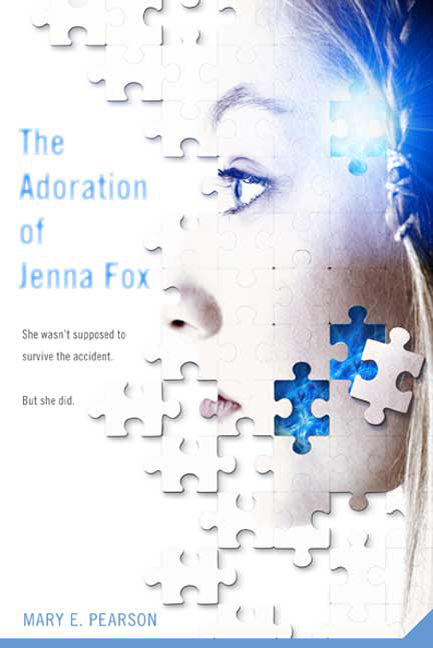
Jenna struggles to put her life in order by watching home videos that her parents had compiled. When she starts to remember things, they don't add up. Why is she a walking history book all of a sudden? How can she remember being baptised in her infancy? Why does she hear the voices of her best friends, Locke and Kara, in her head?
Something is different about her, but she can't put her finger on it. Why can't she remember? What is her middle name? Why does her grandmother treat her like an outcast? All will be revealed in The Adoration of Jenna Fox.
This book is incredible. I could hardly manage to put it down, but, at the same time, it's a heavy book to carry. It has a lot of deep thinking to it. It questions modern medical theories and asks where the line is to be drawn.
The characters are fantastic, but at the same time a little thin. Jenna and Lily are the two characters that will stand out. Jenna is the focus of the book, so you spend a lot of time in her head. Lily, on the other hand, becomes a brilliant character because she questions things just as you do. She honestly doesn't know what to think about her granddaughter.
My rating is:

For more of my thoughts, check out my Reading Log
Tuesday, November 30, 2010
Frankenstein by Mary Shelley, A Graphic Novel (in original text)

Doctor Frankenstein, or more familiarly Victor, is obsessed with the thought of ridding the human body ( and race for that matter) of any type of disease. His studies take him to Ingolstadt, where he is able to finally put his sharp mind to task and bring forth his dream of an undying human race. But, tragically, his bright dream turns into the darkest of nightmares when his studies turn him to sparking life into a monstrous patchwork of long dead body parts. Then, in his darkest hour, the Frankenstein monster is born...or reborn... or revived depending on your view.
This monstrosity. NO! This abomination wants only to be accepted and treasured as a creation, much as the human raced is treasured by it's one Creator. However, when this wicked spirit finds that no matter where it turns it will always be turned away...things could get nasty. And, in truth, they do. Watch your back Doctor Victor Frankenstein. Your monster has turned it's yellow eyes on you.
I've read both, the original and the graphic novel version, and I must say that this really enhances my understanding of what was being said in th book. I loved this Graphic version of Mary Shelley's classic. I have not read the Quick Text verison, so I can't say much for it, but I think this will really make a high school class really get into what is being said. Some of the language and phrasing is a bit out dated (at least by some standards) and they think that kids reading a Shelley novel is ridiculous, but this book really bridges the gap. Not to mention that reading a graphic novel is introducing a student to a different mode of expression and creation.
The colors are dark and menacing for the most part, but at times there are bright and exciting pictures. The frames really bring the characters to life without distracting too much from what is being said.
My opinion...Though it lacks all the words of Shelley's novel, it proves to be a very, very close second.
Sunday, November 28, 2010
The Book Thief by Markus Zusak

The Book Thief is about a little girl, Liesel Meminger, and her life through World War II and the Holocaust. Liesel, as far as we know, is not a Jew, but her family is accused of having Communist ties. Her mother took measures into her own and ran with Liesel and Liesel's little brother. Liesel's little brother contracted an illness and died on the way to Molching, a town not far from Munich. There, in Molching, Liesel is given over to a new family and left.
The little girl, now haunted with nightmares of her brother, is shoved into school where she struggled because she cannot read. She had to cope with a new family, new friends, and new enemies. What she didn't know, since she was only a little girl, was that her list of enemies was going to grow from a few schoolyard bullies to Adolf Hitler and his armies.
She also didn't know the kind of trouble she was going to attract. She becomes a book thief, a Jew harborer, a "Jew Lover", and so much more. Liesel was the epitome of Adolf's nightmare (a free thinking, individual, unstoppable person). But will Liesel escape the ravages of war, or will Death (the narrator of her story) finally catch up to her?
I, personally, am not a fan of this book. The author, Markus Zusak, gave too much away for me to really enjoy it. I like books that keep me in suspense. This book didn't. It told you everything significant that was going to happen before you ever discovered it on your own.
Now, there were good points to this book. The writing style, besides his lack of suspense, was very interesting. He really took a child-like manner in describing the weather and the events that happened. It made the world seem both magical and frightening at the same time. Zusak also created some amazing ideas about Death. Some of them are far-fetched, but at least he tried something new.
The characters are okay. None of them really stood out to me. I had some problems remembering that Liesel was a young girl. I kept thinking she was in her upper teens, which she most definitely is not. You learned too much about each character to really need to get to know them. You have no desire to want to see them more if you already know everything about them.
My rating is:

For more of my thoughts, check out my Reading Log
Thursday, October 28, 2010
Speak by Laurie Halse Anderson

Check out my Speak Book Trailer!
"The first ten lies they tell you in high school
1. We are here to help you.
2.You will have enough time to get to your class before the bell rings.
3. The dress code will be enforced.
4. No smoking is allowed on school grounds.
5. Our football team will win the championship this year.
6. We expect more of you here.
7. Guidance counselors are always available to listen.
8. Your schedule was created with your needs in mind.
9. Your locker combination is private.
10. These will be the years you look back on fondly. (Speak, pgs. 5-6)"
Mel's first day of high school is terrible. On her way to school, none of her old friends talk to her. All of the other students eye her like she is a freak. She wants to explain it to them all, but something stops her. She can't speak about it. Everytime she tries, her throat closes up and she chokes on her words.
After school she goes home, eats pizza, and runs upstairs to hide from her parents. They don't want to hear from her. They don't even want to see her. Things aren't looking good for her first year of high school.
Things get worse when IT keeps popping up in her life. He talks to her, tries to get her attention. Why is she being punished? Will she ever be able to tell her secret? Will she ever get her old life back?
Anderson created an awesome character that deals with extremely hard topics. One of the major themes is identity and finding your place in the world. It also deals with growth and communication. Laurie Halse Anderson pulled the most difficult struggles a teen faces and then explores them with sarcasm, wit and sincerity.
For more of my thoughts check out my Reading Log.
Thursday, October 21, 2010
American Born Chinese by Gene Luen Yang

The Monkey King is just that, a monkey that is a king of monkeys. However, this monkey knows different forms of kung fu and considers himself to be a deity. One night, he smells food from a heavenly dinner party and decides that he wants to attend, even without an invitation. Once he arrives in heaven and tries to enter the party, the other gods mock him. They call him a simple monkey and say that he will never be anything more than that. The Monkey King's reaction? He pummels them all and sets out to prove himself as a deity equal of all of those in heaven.
Jin was born in the United States to Asian parents, but he still faces the difficulty of stereotypes and the sting of racial discrimination. It is clear that the color of his skin and the slant of his eyes is enough to separate him from the rest of the class. When Jin meets another boy named Wei-Chen Sun, he struggles to "fix" the other boy's broken English so that he will not be embarrassed. And, as you see him grow up, Jin struggles with his heritage limiting not only his friends, but also the girls that he is interested in.
Danny is a normal teen with a terrifying secret: his cousin Chin-kee. Danny is embarrassed by his cousin's broken English and odd mannerisms. Danny has to take Chin-kee to school with him and it is devastating. Danny says it messes with his life and claims that he has to switch schools after every visit his cousin makes. This time Danny refuses to let his cousin mess up his life. But how will he stop his strange cousin?
These three tales are woven together to create a strange and unique tale. It's full of hilarious inuendos and hidden meanings and the art is amazing. Yang uses this story to explore the problems of racism and stereotypes. His characters express his feelings and thoughts about growing up. His book begs the question of: what would you do to fit in?

For more of my thoughts check out my Reading Log
Monday, October 18, 2010
The Scarlet Letter (Graphic Novel) by Nathaniel Hawthorne

Hester Prynne, after being found out of adultry, must wear the scarlet letter "A" upon her chest. She must suffer the insults and attacks of her Puritan neighbors. The judges plead with her to name the man that she committed adultry with, but she refuses them. There is nothing left for her except to take care of her baby girl, Pearl, and to hide the identity of her lover (even from her husband).
I know that there is much more to this story than what this thin graphic novel version is telling us. I am really wanting to read the whole thing now.
There are a few things that I didn't understand. Did her she marry her husband because it was arranged? Or was she, at one time, in love with him? I think that is a critical piece of information that was left out! Were there any other stipulations placed on her by the judges? Or was wearing the A punishment enough? And why did she embroider her letter in that way? It really didn't answer these questions.
It did deal with some interesting issues and this book might spark some religious questions. I think I would really like the full version and, at my earliest convenience, I plan to buy it.
I can't rate this higher because it left so much unsaid, but I can't give it lower because it did a great job getting some of the major themes across. So, I will give it a temporary three, until I can better judge it.

Saturday, October 16, 2010
By the Time You Read This, I'll Be Dead by Julie Anne Peters

Daelyn has been ridiculed and mocked her entire life. She's been made fun of for her weight, for her looks and she's nearly been raped. She tried to kill herself, but she had timed it wrong; her parents had found her and managed to get her to a hospital. Now, she wears a neckbrace and can no longer speak. She suffers in silence.
However, she hasn't given up her plans to kill herself. The story picks up with Daelyn as she is planning her next attempt at killing herself. She realizes that now she has to plan more carefully, she has to make things just right. She also realizes that she would have left a large mess for her parents to clean up. So, this time, she is going to do it right. She gets on a website that sets up a twenty-three day program for her. All she has to do is wait twenty three days and she can kill herself. She's suffered for 15 years; what's another few days?
What she doesn't plan on is Santana. He is a boy that tries to talk to her after school. She refuses to acknowledge his existence, but he cannot be dissuaded. Nor does she consider Emily. Emily is a "fat" girl at school that tries to open up to her. Daelyn is going crazy! She has finally found a way to kill herself, and everyone decides to start paying attention to her.
When the final day comes will she be prepared to die or will she second guess herself.
This novel deals with the touchy subject of bullycide or suicide because someone has bullied you to the point where you break. In class, this book brought up amazing conversations and opinions. This book does have some very dangerous material and must be presented in the right ways.
City of Bones by Cassandra Clare

The next day, Clary ends up in an argument with her mom. She storms out of the house with her best friend Simon and go to a poetry reading. There, she sees Jace, one of the Nephilim from the night before. Apparently, he had been following her because she intrigued him. Then, Clary recieves a disturbing call from her mom. She races home to find the house trashed and empty, or almost empty. She comes face to face with a demon. She manages to kill the little beast, but not before getting poisoned by it. Jace, who followed her again, saves her by taking her to the Institute.
Clary, then, begins the hunt for her mother. Along the way, she learns amazing secrets about herself and about her mom.
Clare did a fantastic job on this novel. It left me wanting to go directly out and get the next part in the series. Once more she goes along the theme of finding one's self and learning to be comfortable with who you are. The cast is set up amazingly. Each character, in their own way, makes the scenes they are in. Jace, Simon, Alec and Isabelle help create complex social issues that Clary has to go through.
However, once more, Clary seems to be underdeveloped. At times you like, at other times she's your worst enemy. You can never tell exactly how you feel. Maybe, as the series goes on, you can learn to like her.
Clockwork Angel by Cassandra Clare

Tessa finds herself in a new world. Warlocks, Vampires, Werewolves and Demons are real. The Nephilim, half-angels half-men, hunt demons and keep the human populace ignorant of their "Downworlder" neighbors, and Tessa is staying in the Nephilim's Institute. Here she gets to know Will and Jem, a pair of shadowhunters (a more familiar name for the Nephilim) and together they start the search for Nate, Tess' brother. This search leads them ever closer to the dangerous "Magister" and his clockwork army.
This book is extremely entertaining! It took me three days to read this book, only because I had to stop myself to read for my classes. She uses a ton of sarcasm and witty comments to make her characters more enjoyable and familiar to us, the reader. Though Tessa is the main character, she isn't the character that you fall in love with. Will and Jem, the shadowhunters, are the ones that steal the show. Will is the sarcastic character that never lets you more than skin deep. He uses his wit to hide away his true thoughts and emotions. Jem is the opposite. He is all accepting. He doesn't judge, he doesn't turn away. I can't wait to find out more about these two in the next installment of the trilogy.
Clare takes an interesting look at stereotypes and racism. She uses the shadowhunters, the downworlders, the mundanes and the demons and shows the hatred and prejudices that each group holds for the other. She uses Tessa to question the views of the Nephilim and through this, show the folly of our views against others that are not like us. There are also themes such as identity and good and evil that are prevalant throughout the novel.

Friday, September 24, 2010
Mexican Whiteboy by Matt de la Pena

Danny, as the title says, is half-Mexican half-white. Danny's father, whom he loves, is Mexican and his mom is white. Danny's dad has disappeared to Mexico and his mom is left to take care of Danny and his little sister. When Danny's mom announces that he has one of two choices, (either go with her to live with her boyfriend Randy or to go to visit his cousins) he chooses to visit his family.
While living with his cousins, Danny runs into Uno. Uno is a half-black half-Mexican boy. He and Danny have much in common, but there first meeting is filled with conflict. Danny shows Uno up at playing baseball and Uno retaliates. Later, Uno realizes that Danny (and Danny's baseball skills) is his best bet to make the money he needs to go and live with his dad. So, Uno sets out to make things right and make a business deal with Danny. This business deal involves a little shady business, but they both really want to live with their dads. Is it worth the effort or will they get into big trouble?
Mexican Whiteboy covers a range of topics. He discusses the importance of a father-son relationship and how Danny deals with that. Pena also brings up important issues like: multi-culturalism and how that can affect identity, self-mutilation, violence, crime, reality v.s. imagination, the stark reality of sterotypes and rascism. This book reveals a world where everyone views everyone else as the lucky ones and sheds light on the fact that we all can be who we want to be.
Pena has an amazing touch with creating characters and letting you in on their thoughts and personal lives. I have a tie on my favorite characters. Raul and Lolo are best friends but also rivals. They are so much fun when they pick on each other. The way Lolo speaks, with his broken English, makes his statements so much funnier.

Tuesday, September 21, 2010
Mississippi Trial, 1955 by Chris Crowe

Hiram Hillburn, one of the youngest from the stubborn Hillburn family, lived with his grandparents for most of his adolescent years. He would wake up early in the morning to the smell of bacon cooking in the kitchen. He would spend lazy mornings with his grandpa, visiting the fields or fishing on the Yazoo river. Then, while his grandpa would visit with friends, Hiram would buy a 5 cent Coke and visit with a blind, local vendor.
Hiram's grandma passes away in the middle of the night and Hiram's world is turned topsy-turvy. His father and mother come in for the funeral and decide to take Hiram back with them. Though he doesn't want to leave his grandpa, he cannot fight his dad. At least, not out right. The young boy does argue with and pesters his dad for the chance to go back to Mississippi and visit his grandpa. Then, in the summer of 1955, Hiram's grandpa has a stroke and he is sent down to his grandpa get back on his feet.
When young mister Hillburn gets off the train in Greenwood, he meets a black youth from Chicago. Everyone calls this black boy "Bobo," but his real name is Emmett Till. Emmett is not used to the south and thier ways. He is used to being treated as an equal to white men, but in Mississippi he is no better than a common slave. Hiram briefly befriends the black youth and that is where things turn bad.
Some time later Emmett goes missing. He was rumored to have whistled at a white woman and then he was kidnapped. It turns out that he was actually tortured and murdered. His body was fished out of the river. As the news of Emmett's kidnapping and death races across the country, Hiram is faced with a terrible dilemma. He might have information that could help convict one of Emmett's killings. But he must decide whether it is worth turning against his fellow white men and standing up for a black youth. But, in a little town where everyone has secrets, you never know what you might find out.
This book had some good points and some bad points. The story was very good and it discussed some real issues such as: racism, tradition and education. The book is actually based on a true story. It is one of the only historical fiction novels that I have read, and I did enjoy it. However, the writing was basic and flat. It had the potential to be an amazing story, but it fell short on holding my attention. I also didn't like that you didn't know fact from fiction until the very end.
Subscribe to:
Posts (Atom)